Wednesday, 17 March 2010

Celebrate Saint Patrick's Day with a Guinness


There is no more easily procurable, satisfying, affordable and socially lubricating way of celebrating Saint Patrick's Day than pushing back a pint (or its more dainty sister the half-pint) of Guinness with some friends. Gastronomically speaking, Guinness is Ireland's greatest contribution to the modern world. There are a few other reasonable contendors, like McCann's steel-cut Irish oatmeal, but do you really see people asking their buds to join them after work for a warm bowl? Oatmeal is just not social. Corned beef with boiled cabbage is a Saint Patty's Day tradition in many American homes, but it's not hard to think of other foods one would rather eat. Guinness, on the other hand, is a whole other story. To begin with, no one needs a special occasion to drink a Guinness. That is a true sign of its greatness.

I thought it appropriate to dedicate this Saint Patrick's Day to learning more about this great beer. So I hopped a plane to Dublin.
The Birth of Guinness


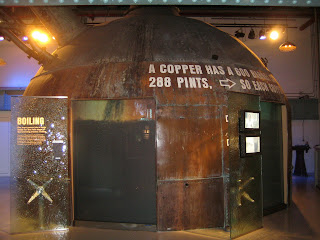
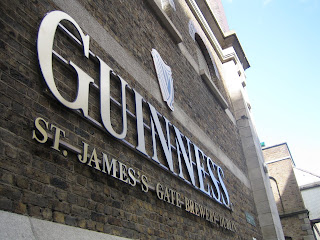
Upon arrival in Ireland, I headed straight to Guinness's Saint James's Gate brewery, the house's original location. After an exhaustive inspection of the grounds (a.k.a. a self-guided tour) I learned the following:

In 1759 Arthur Guinness signed a 9,000-year lease for a brewery in Dublin called Saint James's Gate at the bargain prices of only 45 pounds' rent per year for a 4 acre property. (In later years the brewery expanded, but according to the Guinness company it would seem that the original lease agreement still applies to the original four acres. I'm not sure why they say "seem" since if anyone should know whether it does, they should.) The brewery was not in great shape when Arthur bought it, but he quickly got it up and brewing, and after only ten years he was even exporting beer to England. Then, in the 1770s Arthur tried his hand at a new style of beer emerging from England called a porter, a dark-colored beer that for the first time used roasted barley as an ingredient.

Stouts and porters

Lore has it that porter beers were named after the London street and river porters who popularized them. Traditionally, a brewery reserved the name "stout" (as in strong) for its strongest beers, those highest in alcohol. Hence, "stout porters" were originally those porters that were higher in alcohol. Guinness became famous for its stout porter, whose name in time was shortened to just plain "stout." Today, the terms "stout" and "porter" are sometimes (confusingly!) used interchangeably. Interestingly, most modern Guinness is weaker than it was in the 19th century, but the brewery does put out some versions that are higher in alcohol.

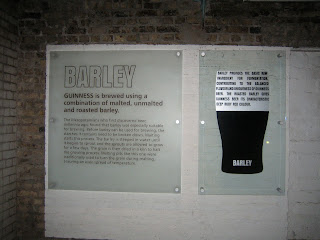
The brewery tour was full of information on how Guinness is made, including the ingredients used (barley, hops, water and yeast) ...

... and details of the brewing process.


... but I'd had enough theory for the time being. Off to the top floor bar for some practice.

The art of the pour


I then jetted back to the U.S. to celebrate Saint Patty's Day with my compatriots and share my new-found knowledge. I was greeted by the following posting at a local establishment:


Saturday, 13 February 2010

Say I Love You with Cheese


What types of food do we think of as romantic?

Cheese? Well, there is one cheese that comes to mind: Neufchâtel. It’s from Normandy, a region in the northwest of France, and it is typically the shape of a heart. (Not to be confused with what Kraft markets as a low-calorie version of Philadelphia cream cheese--also, alas, called Neufchatel.)

The history of a cheese Valentine

Apparently, young Norman women for centuries have used these heart-shaped cheeses to communicate their love to the objects of their desire. A Valentine made of cheese. According to www.easy-french-food.com French farmgirls used the cheese to “woo the affections of British soldiers who were passing through during the Hundred Years War in the Middle Ages.” Cheese, the universal language. Even though women’s liberation has since rendered such discreet expressions of love unnecessary, the tradition of the heart-shaped Neufchâtel happily endures. (Neufchâtel also comes in other shapes, like logs and circles, but why buy them?)

A.K.A. Cœurs de Bray

The heart-shaped Neufchâtels are also sometimes called Cœurs de Bray, meaning Hearts of Bray, since the cheese is from an area in the northeastern part of Normandy called the Pays de Bray (Land of Bray). "Bray" is old French for marsh, swamp or mud, a reference to the area's soil. (I cannot personally vouch for its swampiness.) Neufchâtel-en-Bray is one of the main towns of the Pays de Bray, hence the cheese's name: Neufchâtel.

But what does it taste like?

Neufchâtel is a soft cow’s milk cheese with an edible bloomy white rind. “Bloomy rind” is cheese-speak for having an exterior covered with thin layer of a powdery white substance that I think is probably mold. I couldn’t, however, find a source that explicitly said “bloom = mold.” (You can bone up on your cheese jargon with the online glossary of the famed New York cheese shop, Murray's Cheese, at www.murrayscheese.com/edu_glossary.asp .) Whether you eat the rind or not is a matter of preference--and sometimes a cause for heated discussion. Neufchâtel is dense and creamy, similar to a Camembert but more delicate and slightly less gooey. Love at first bite (to end on an appropriately cheesy note)?

Happy Valentine’s Day!

Kisses,

J.P.